
Pruning
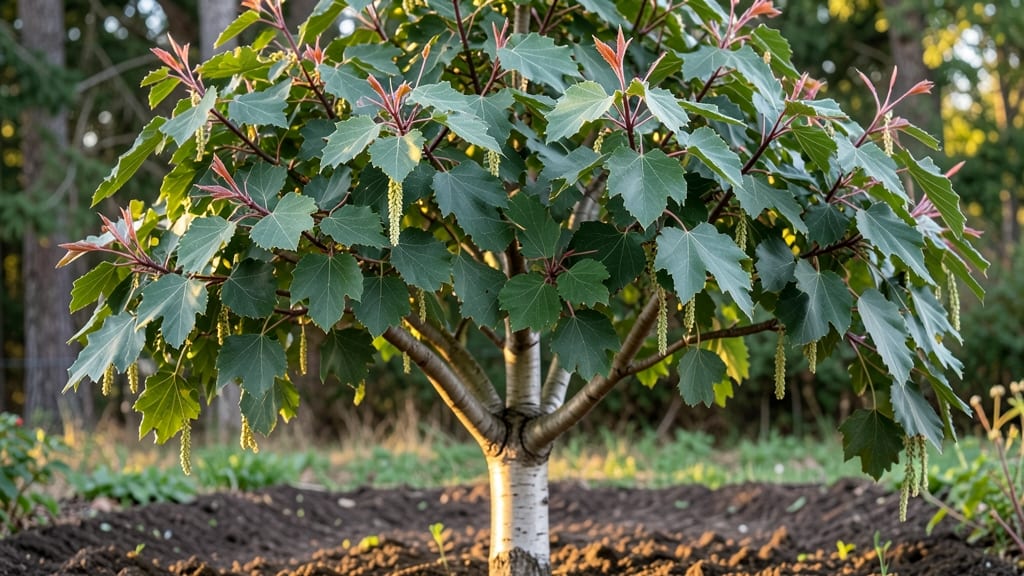
A mulberry tree in spring bursts with new growth—leaves, flowers, and fruit—while needing careful pruning to maintain vigor. Trim after flowering (late spring) but before summer heat arrives, removing dead branches and shaping for sunlight access to maximize fruit production.
Spring is when mulberry trees really come alive—you'll see fresh foliage emerge first, followed by delicate flowers that eventually become sweet berries. 🌸 The key to pruning is timing: cutting too early can damage new growth, while waiting too long stresses the tree before summer's heat.
I always prioritize removing crossing branches or dead wood first, then thin out crowded areas to let sunlight reach the center. This approach boosts both fruit yield and overall tree health.
What many gardeners overlook is how mulberry trees respond to pruning stress.
These trees are particularly sensitive in spring because their energy is focused on new growth rather than recovery. 🌿 By pruning after flowering but before summer, you give the tree time to heal while still encouraging strong fruit development for next season.
Just remember: never remove more than 25% of the canopy at once, or you risk stunting the tree's productivity.
💡 In This Article
- Spring Mulberry Tree Growth Stages and Biological Needs
- Step-by-Step Spring Pruning Guide for Mulberry Trees
Spring mulberry tree growth stages and biological needs
Mulberry trees enter spring with a precise biological sequence that determines their pruning sensitivity. First, the tree's dormant buds swell in early spring (March-April in most regions), breaking dormancy when daytime temperatures consistently reach 50-55°F.
This triggers leaf emergence, which typically occurs 2-4 weeks after bud swell, depending on local climate. The leaves develop rapidly to capture sunlight for photosynthesis, a process that powers the tree's entire growth cycle—including flower development.
The flower buds appear shortly after leaf emergence, usually in late April to early May, and require 10-14 days of warm weather (60°F+) to fully open. These flowers are crucial because they develop into the tree's fruit, which matures over 6-8 weeks.
What's fascinating is how mulberry trees allocate energy: up to 70% of spring growth energy goes toward fruit production, making pruning at this stage particularly risky. The tree's root system also expands aggressively in spring, absorbing water and nutrients to support this rapid above-ground growth.
Humidity plays a surprising role in pruning sensitivity. Mulberry trees in high-humidity regions (like the Southeast U.S.) have softer, more delicate new growth that heals more slowly after cuts. In contrast, trees in drier climates (like the Southwest) develop thicker bark faster, making them more resilient to pruning.
This is why I always check the 10-day weather forecast before pruning—if rain is predicted, I delay cutting to prevent fungal infections in fresh wounds. The tree's sap flow also peaks in spring, which can make cuts bleed heavily for 1-2 weeks.
What most gardeners miss is how mulberry trees prioritize their growth. When you prune too early, you're interrupting the tree's natural sequence: first leaves, then flowers, then fruit.
Cutting before flowering removes potential fruit-bearing branches, while pruning after flowering but before summer heat gives the tree time to recover before the stress of summer drought and heat.
The ideal timing window is typically 2-4 weeks after flowering, when the fruit is still small (pea-sized) but the leaves have fully hardened.
Consider these biological factors when planning your pruning:
- Leaf emergence: First sign of new growth (typically March-April)
- Flowering: Occurs 2-4 weeks after leaves emerge, critical for fruit production
- Fruit development: Begins 2 weeks after flowering, reaches harvest size in 6-8 weeks
- Root expansion: Peaks in late spring, supporting above-ground growth
The tree's growth hormone balance shifts dramatically in spring. Auxin, a growth hormone concentrated in young leaves, inhibits branching near the tips. This is why mulberry trees often develop dense canopies—pruning too aggressively can disrupt this natural hormone distribution, leading to sparse fruiting the following year.
The key is to work with the tree's natural rhythm rather than against it. 🌱