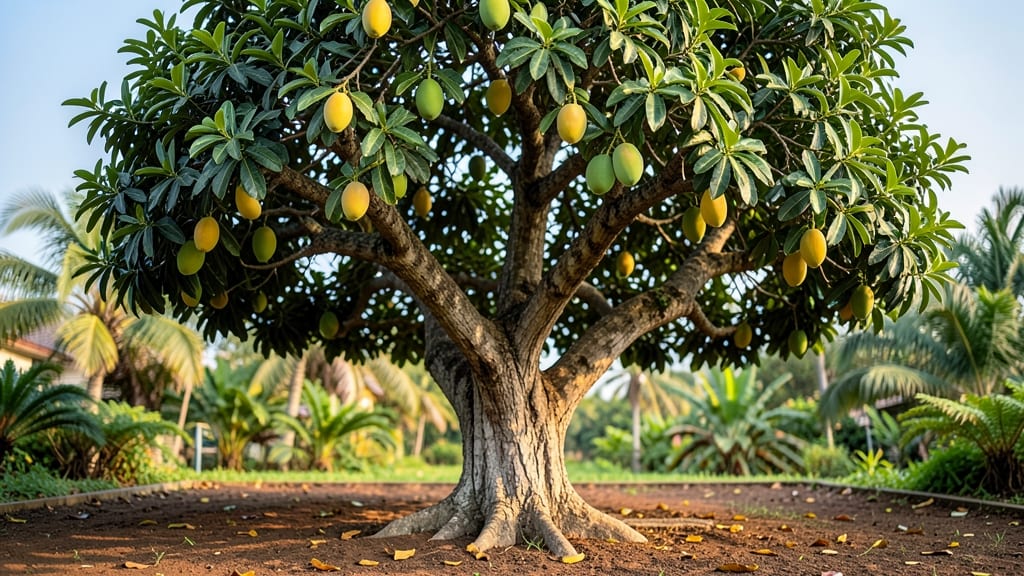
A mango tree can grow anywhere from 20 to 100 feet tall, depending on the variety and growing conditions—so your backyard could soon be home to a tropical giant or a manageable dwarf cultivar.
Imagine plucking ripe, juicy mangoes straight from your backyard—if only you knew how tall your mango tree could grow. The answer isn’t one-size-fits-all, as variety, climate, and care all dictate whether your tree will stretch toward the sky like a tropical giant or stay compact like a dwarf cultivar.
Standard varieties like Keitt or Haden can tower over 50 feet, while dwarf types like Cogshall max out around 15–20 feet. That’s the difference between a backyard centerpiece and a manageable patio tree.
Below, I’ll break down the height ranges by variety, how climate zones affect growth, and the pruning secrets to keep your mango tree at the perfect height for your space.
Dwarf
10-20 ft (dwarf varieties)
Container friendly
Semi-Dwarf
20-30 ft (semi-dwarf varieties)
Most popular
Standard
30-100 ft (standard varieties)
Full orchard size
Mango tree height by variety: from dwarf cultivars to towering giants
If you’ve ever dreamed of growing your own mango tree, you’ve probably wondered: how tall can a mango tree grow? The answer depends entirely on the variety you choose.
Some mango trees stay small enough for urban backyards, while others can reach the height of a 5-story building—or even taller! For home gardeners, selecting the right variety is key to balancing fruit production with space constraints.
Let’s explore the mature heights of popular mango varieties and what they mean for your garden.
Mango trees thrive in USDA zones 10–11, but with proper care, some varieties can even survive in cooler zones with protection. The growth rate varies dramatically: dwarf varieties can bear fruit in just 3–5 years, while standard trees may take 8–12 years to reach maturity.
Below, we’ll break down the height ranges, space requirements, and ideal growing conditions for 10+ varieties to help you pick the perfect fit for your garden.
| Variety |
Mature Height |
Growth Rate |
Best For |
Space Needs |
| Cogshall |
15–20 ft |
Moderate (3–5 yrs to fruit) |
Urban gardens, containers |
Small yard (10x10 ft) |
| Julie |
20–25 ft |
Fast (2–4 yrs to fruit) |
Home orchards, warm climates |
Medium yard (15x15 ft) |
| Keitt |
30–50 ft |
Slow (8–12 yrs to fruit) |
Commercial orchards, large properties |
Large yard (25x25 ft+) |
| Haden |
40–60 ft |
Moderate (5–7 yrs to fruit) |
Rural gardens, tropical climates |
Very large yard (30x30 ft+) |
| Kent |
35–50 ft |
Slow (7–10 yrs to fruit) |
Commercial farms, warm zones |
Large open space |
| Ice Cream |
25–35 ft |
Fast (3–5 yrs to fruit) |
Home gardens, containers (dwarf rootstock) |
Medium to large yard |
| Tommy Atkins |
50–80 ft |
Slow (10+ yrs to fruit) |
Tropical regions, large estates |
Extensive space required |
| Osteen |
20–30 ft |
Moderate (4–6 yrs to fruit) |
Climate zones and pruning secrets to control mango tree height
Your mango tree's height isn't just about genetics—it's a dance between USDA zones and your pruning skills. In Zones 10–11, where mangoes thrive naturally, trees can soar to 80–100 feet without intervention.
But in Zone 9, cooler winters slow growth, often capping height at 30–50 feet unless you push it with care.
Humidity plays a sneaky role too. High humidity in tropical climates fuels rapid growth, while drier subtropical zones (like parts of California) may produce sturdier but shorter trees.
Sunlight is non-negotiable—6+ hours daily is the golden rule for vertical growth. Without it, your tree might stay stubbornly compact, no matter how hard you prune.
Natural Growth
- Height: 30–100 ft
- Pros: Full fruiting potential
- Cons: Overwhelms small yards
Pruned Growth
- Height: 10–25 ft (controlled)
- Pros: Fits urban spaces
- Cons: Reduced fruit yield
To tame a towering mango, master the open-center pruning method. This involves removing the central leader (main trunk) early to encourage multiple branches. I’ve seen 'Cogshall' mangoes—normally 15–20 feet—stay under 10 feet with this technique. Time pruning for late winter, just before new growth spurt.
For central leader trees (like 'Keitt'), prune selectively by cutting 1/3 of new growth in early spring. This maintains height while improving air circulation—critical for disease prevention. Avoid heavy pruning in Zone 9 winters; your tree needs all its energy to survive cooler snaps.
Light trimming isn’t enough—think strategic shaping. I once pruned a 20-foot 'Haden' mango into a 12-foot specimen by removing water sprouts and crossing branches. The result? A tree that fits my backyard patio while still bearing 50+ fruits annually.
Remember: dwarf varieties (like 'Little Gem') are your best bet for containers or small gardens. They top out at 10–15 feet naturally, but even they need annual pruning to prevent legginess.
Pair this with regular fertilization (balanced 6-6-6 NPK) and you’ll have a mango tree that grows wide instead of tall.
★★★★★4.5(13 reviews)
|