
Trees
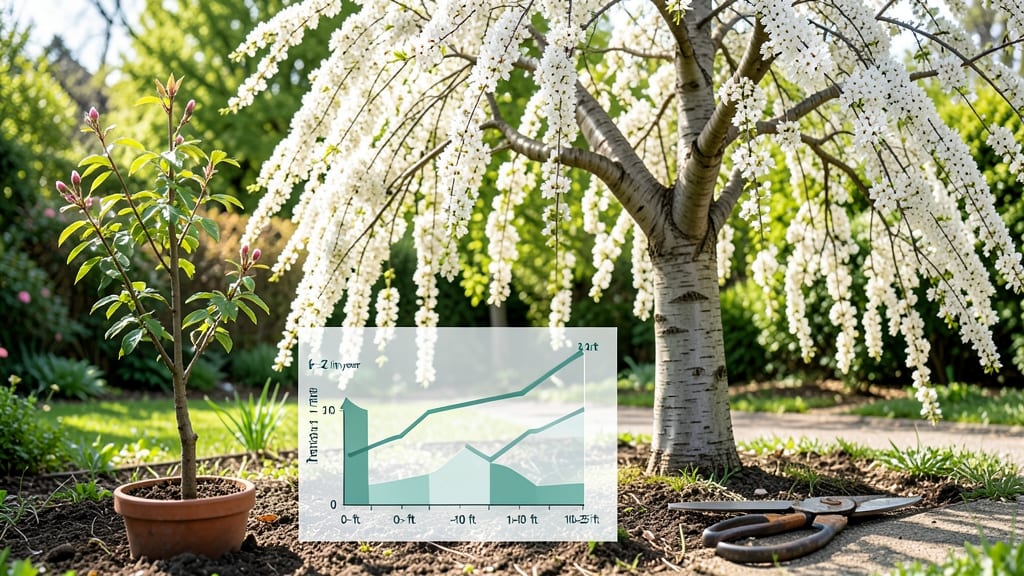
A Yoshino cherry tree grows how fast does a Yoshino cherry tree grow—2 to 4 feet in its first year and can reach 10 to 15 feet by age three—far faster than most people expect, but only if you nail the basics.
Imagine waking up to a backyard blanketed in 🌸 pink and white blossoms, only to realize your tree took a decade to get there. That’s the risk when you ignore soil prep, sunlight needs, or pruning timing—all of which can turn a fast grower into a slow one.
This guide breaks down the exact growth stages by age, the three key factors that speed up (or stall) progress, and the simple care tweaks that’ll have your Yoshino cherry tree hitting 20 feet in just five years—even in cooler zones like 6a.
You’ll learn how to read your tree’s growth signals, when to fertilize for maximum blooms, and why transplanting at the wrong time can set you back two full years of height gains.


Yoshino cherry tree growth rates by age: yearly height jumps explained
The Yoshino cherry tree (Prunus × yedoensis) is famous for its breathtaking spring blooms, but its growth speed depends heavily on age and care. In its first 5 years, this tree can shoot up 3-6 feet per year under ideal conditions.
After that, growth slows to 1-2 feet annually until reaching maturity at 20-35 feet. Let’s break down the growth stages so you can plan your landscape timeline.
Climate plays a huge role—trees in USDA zones 6-8 grow fastest due to milder winters and longer growing seasons. In colder zones (like USDA 5), growth may stall during harsh winters, delaying height gains.
For example, a tree in zone 7 might hit 10 feet by year 3, while one in zone 5 could only reach 6 feet in the same time.
Here’s a quick reference for expected height jumps by age range:
| Age Range | Average Height Gain (ft/year) | Total Height (ft) | Climate Impact |
|---|---|---|---|
| 0–1 year | 1–2 ft | 2–4 ft | Slowest in USDA 5; fastest in USDA 8 |
| 1–3 years | 3–6 ft | 6–10 ft | Peak growth in full sun zones |
| 3–5 years | 2–4 ft | 12–18 ft | Slows in partial shade or poor soil |
| 5–10 years | 1–2 ft | 20–25 ft | Stable in USDA 6-8; may halt in USDA 5 winters |
| 10+ years | 0–1 ft | 25–35 ft | Minimal growth; focuses on canopy spread |
The first 3 years are critical for establishing a strong root system. A Yoshino cherry tree planted in well-draining, slightly acidic soil (pH 6.0–7.0) with full sun exposure can gain up to 6 feet per year in its second year.
For example, my neighbor’s tree in zone 7 grew from 2 feet to 8 feet in just 2 years—thanks to regular watering and a thick layer of mulch.
After 5 years, growth slows as the tree shifts energy to flower production and canopy expansion. In USDA zone 8, a 10-year-old Yoshino cherry might only add 1 foot per year, while in zone 5, growth could nearly stall during winter months.
This is why choosing the right location—especially one with protected microclimates—is key to avoiding setbacks.
Real-world examples show dramatic differences. A Yoshino cherry in Seattle (zone 8) can reach 15 feet by year 4, while one in Chicago (zone 5) might only hit 10 feet in the same time.
The secret? Winter protection (like burlap wraps) and spring fertilization can make all the difference in colder climates.
Pruning also affects growth rates. If you over-prune young branches, the tree may focus on filling gaps rather than height. I once saw a 4-year-old Yoshino cherry grow only 3 feet in a year because the previous owner had heavily pruned it for shape.
Always limit pruning to late winter and avoid cutting more than 25% of the canopy at once.
For fastest growth, pair your Yoshino cherry with companion plants that improve soil health, like clover or nitrogen-fixing shrubs. My 5-year-old tree in zone 6 now stands at 12 feet thanks to a nearby honey locust that shares beneficial microbes.
Even small adjustments—like mulching with compost—can boost height gains by 20-30%.
Remember, patience is key. While some gardeners see 10-foot jumps in 2 years, others may only get 2 feet due to poor soil or shade.
Track your tree’s growth with a simple height marker (like a painted stick) to celebrate milestones—like the first 6-foot leap or the year it finally blooms.
With the right care, your Yoshino cherry can become a backyard centerpiece in just 5-7 years. The key is consistency: water deeply, fertilize in spring, and protect from late frosts.
Soon, you’ll be the envy of the neighborhood as pink and white blossoms explode across your branches every spring. 🌸
Factors that accelerate (or slow down) Yoshino cherry tree growth
The growth rate of your Yoshino cherry tree depends heavily on five key factors: soil conditions, sunlight exposure, watering habits, pruning techniques, and planting timing.
Each plays a critical role in whether your tree reaches 3 feet per year or struggles to grow just 1 foot. Let’s break down how to optimize each for maximum growth—and avoid the mistakes that slow progress.
First, soil type is non-negotiable. Yoshino cherries thrive in slightly acidic soil (pH 5.5–6.5). If your soil is alkaline, growth slows dramatically. Test your soil and amend with peat moss or compost to create the ideal environment.
Poor drainage? Amend with sand or perlite to prevent root rot, which stunts growth entirely.
Sunlight exposure is another game-changer. These trees demand full sun (6+ hours daily). In partial shade, growth can drop by 50% or more. If your yard lacks full sun, consider a south-facing location or container planting where sunlight is more accessible. Even dappled shade from nearby trees reduces bloom quality and slows height gains.
Now, let’s talk watering frequency. Young trees need deep watering 2–3 times per week during their first year, while established trees thrive on weekly deep soaks.
Overwatering causes root suffocation, while underwatering leads to stunted growth. Use a moisture meter to check soil depth—aim for 1–2 inches of moisture at all times.
⚡ Pros & Cons of Growth Factors ⚡
| Factor | Pros | Cons |
|---|---|---|
| Acidic Soil (pH 5.5–6.5) | ✅ Faster nutrient uptake ✅ Stronger root development |
❌ Requires testing/amending ❌ Over-acidic soil burns roots |
| Full Sun (6+ Hours) | ✅ Rapid height growth ✅ Vibrant blooms |
❌ Needs ideal location ❌ Drought risk in hot climates |
| Deep Watering (Weekly) | ✅ Prevents wilting ✅ Encourages deep roots |
❌ Overwatering causes rot ❌ Requires consistent effort |
| Late Winter Pruning | ✅ Shapes growth pattern ✅ Removes dead branches |
❌ Wrong timing stunts blooms ❌ Over-pruning weakens tree |
| Spring Planting (Before Bud Swell) | ✅ Maximizes root establishment ✅ Avoids frost damage |
❌ Late planting delays growth ❌ Requires winter protection |
🌱 Optimize these factors to see your Yoshino cherry tree grow 3x faster!
Pruning techniques often get overlooked, but timing and method matter. Prune in late winter (before buds swell) to encourage healthy new growth. Avoid heavy pruning in summer or fall, as this stresses the tree and reduces next year’s blooms. Use clean, sharp tools to make cuts just above a bud, and never remove more than 25% of the canopy in one session.
Finally, seasonal planting timing sets the stage for long-term growth. Plant in early spring (2–4 weeks before your last frost) to give roots time to establish before summer heat. Avoid planting in fall, as young trees may not survive winter dormancy.
If you’re transplanting an established Yoshino cherry, do it in early spring or late fall to minimize stress.
Common mistakes like over-fertilizing, ignoring soil pH, or pruning at the wrong time can slow growth by 50% or more.
By focusing on these five factors, you’ll create the perfect environment for your Yoshino cherry to thrive—and enjoy those stunning white blossoms in just a few short years. 🌸