
Plants
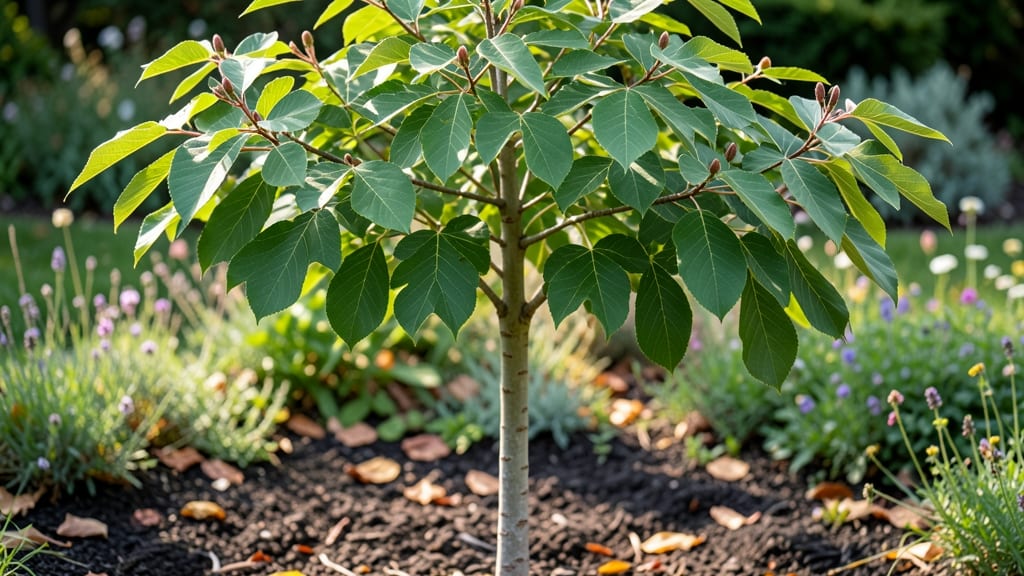
A young walnut tree looks like a graceful, upright sapling with clusters of 5-9 elongated leaflets arranged in compound leaves, smooth gray bark marked by tiny vertical lines, and bright green foliage that matures to a deeper hue. Its growth is slow but steady, adding just 1-3 feet each year.
A young walnut tree's most distinctive feature is its pinnate compound leaves, where each leaf has 5-9 oval-shaped leaflets with serrated edges. 🌿 The bark starts out smooth and gray but develops characteristic vertical grooves as the tree matures.
Unlike some nut trees, walnut saplings grow upright rather than spreading wide, making them easier to spot in wooded areas. The terminal buds are another key identifier—they're elongated and pointed, helping distinguish walnut from similar trees like hickory.
What sets walnut trees apart visually is how their foliage changes with the seasons. New growth appears bright green in spring, gradually deepening to a rich green by summer. This color shift helps gardeners monitor the tree's health throughout the year.
The slow but consistent growth rate means you'll see steady progress over time, though it takes several years before the tree develops its iconic nut-producing branches.
💡 In This Article
- Identifying Walnut Tree Leaves and Bark at Early Stages
- Growth Patterns and Care for Young Walnut Saplings
Identifying walnut tree leaves and bark at early stages
The compound leaves of a young walnut tree are its most striking feature, with each leaf containing 5-9 oval-shaped leaflets arranged alternately along a central stem. These leaflets measure about 2-5 inches long and 1-2 inches wide, with finely serrated edges that give them a delicate, almost lace-like appearance.
The leaflets themselves have a smooth, slightly leathery texture and are arranged in a pinnate pattern, meaning they all radiate from a single central vein. 🌿 This arrangement helps distinguish walnut from similar trees like hickory, whose leaves often have more leaflets (7-17) or pecan trees, which have 11-17 leaflets with a more rounded shape.
When examining the bark, young walnut trees have a smooth, grayish-brown surface with tiny, vertical lines called lenticels that allow gas exchange. These lenticels become more pronounced as the tree ages, eventually developing into the characteristic rough, furrowed bark of mature walnut trees.
English walnut varieties (Juglans regia) tend to have slightly lighter bark compared to black walnut (Juglans nigra), which develops a darker, almost blackish-gray hue as it matures.
The bark's texture is another key identifier—it feels slightly rough to the touch due to the lenticels, unlike the smoother bark of younger hickory or pecan trees.
The foliage of a young walnut tree undergoes noticeable seasonal changes, starting with bright green leaflets in spring that gradually darken to a rich, deep green by summer. This color shift is due to increased chlorophyll production as the tree matures.
In autumn, the leaves turn a warm yellow-brown before falling, a process influenced by photoperiodism—the plant's response to changing daylight hours.
The terminal buds, located at the tips of branches, are another identifying feature—they're elongated and pointed, measuring about 1/4 to 1/2 inch long, and appear slightly darker than the surrounding bark.
What most people overlook is how the leaf arrangement can vary slightly between walnut varieties. Black walnut leaves often have a slightly darker green hue and more pronounced serrations, while English walnut leaves tend to be lighter and slightly broader.
The vein pattern also differs—walnut leaves have prominent secondary veins that create a network of fine lines, giving them a more intricate appearance compared to the simpler vein structure of hickory leaves. These subtle differences become more apparent as the tree grows, but even young saplings show these distinguishing traits.
To further confirm you're looking at a walnut tree, examine the leaf's underside. Walnut leaves have a slightly fuzzy texture on the underside due to fine hairs, which helps reduce water loss and protect against pests.
This feature is less common in related trees and can be a helpful identifier in the field. The combination of these visual cues—compound leaves, smooth gray bark with lenticels, and the distinctive terminal buds—makes young walnut trees relatively easy to identify once you know what to look for.
One common mistake is confusing young walnut trees with butternut or heartnut trees, which also have compound leaves. However, these species typically have 7-13 leaflets with a more rounded shape and lack the walnut's characteristic serrations.
The bark of butternut trees also develops into a more scaly texture as it matures, providing another point of distinction. 🌱