
Trees
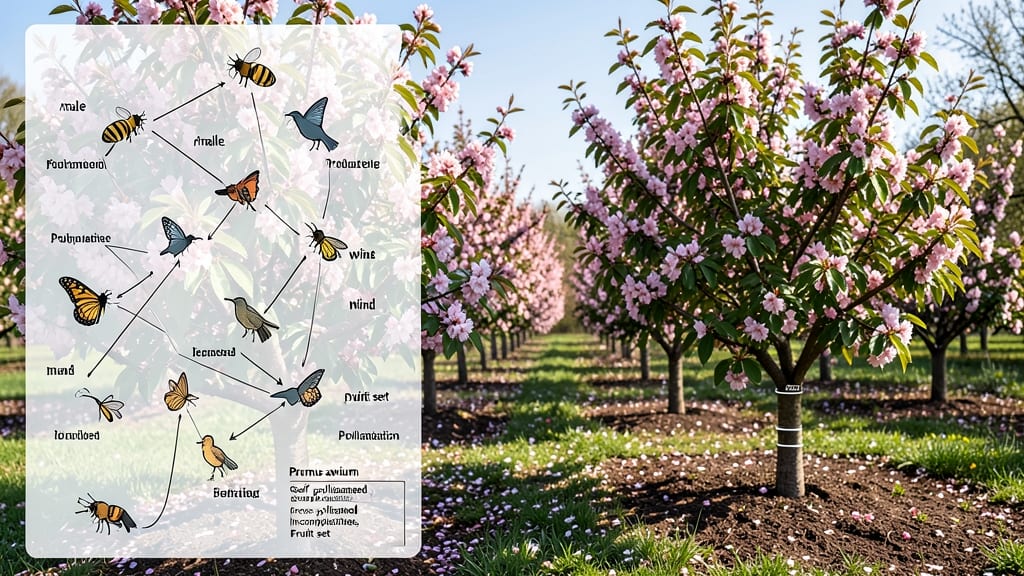
A Bing cherry tree pollination chart reveals this variety cannot fruit on its own and needs compatible partners like Stella or Lapins within 50 feet for successful pollination.
A Bing cherry tree's pollination requirements stem from its biology—its flowers produce pollen that's incompatible with its own ovules, making cross-pollination essential. 🌸 Unlike self-fruitful varieties like Stella, which produce fruit independently, Bing cherries rely on bees transferring pollen between different trees.
Planting two or more compatible varieties ensures better fruit set, as bees naturally visit multiple blooms in close proximity. This system maximizes your harvest potential while accounting for environmental factors like wind patterns or bee activity.
For optimal results, choose varieties with overlapping bloom times—typically within a week of each other. Stella and Lapins are excellent partners because their flowers open simultaneously with Bing cherries, creating ideal conditions for pollination.
The 50-foot rule ensures bees can efficiently travel between trees, though some growers report success with slightly wider spacing in dense plantings.
💡 In This Article
- How Bing Cherry Tree Pollination Works
- Best Pollination Partner Varieties for Bing Cherries
How Bing cherry tree pollination works
The biology behind Bing cherry pollination begins with its flower anatomy, where male and female reproductive parts are positioned to prevent self-pollination. Unlike self-fruitful varieties like Stella, Bing cherries have dichogamous flowers—meaning their stamens (male pollen producers) and pistils (female ovule-bearing structures) mature at different times.
Stamens release pollen 2-3 days before the pistils become receptive, creating a built-in barrier to self-pollination. This mechanism ensures cross-pollination with compatible varieties is the only path to fruit development.
Temperature plays a critical role in this process, as Bing cherries typically bloom in late April to early May when daytime temperatures reach 65-75°F. Cooler weather can delay blooming, while heatwaves may cause premature flower drop.
The flowers also require 100-200 hours of chill hours (temperatures between 32-45°F) during winter dormancy to break dormancy properly. Without sufficient chill hours, flowers may fail to open or produce viable pollen, directly impacting pollination success.
Bees are the primary pollinators, but their efficiency depends on tree placement. When you plant Bing cherries within 50 feet of compatible varieties like Stella or Lapins, bees can easily transfer pollen between trees during their 2-4 hour foraging trips.
The scent of Bing cherry blossoms—often described as a sweet, almond-like fragrance—attracts bees, but the flowers' white petals also provide visual cues that guide pollinators. Unlike self-fruitful varieties, Bing cherries won't set fruit unless pollen from another tree fertilizes their ovules.
Here's what happens when pollination fails: Unfertilized flowers drop off within 7-10 days, leaving no fruit to develop. This is why growers often see "bloom but no fruit" scenarios with solitary Bing trees. The lack of fruit set isn't due to poor tree health—it's purely a biological limitation.
In contrast, self-fruitful varieties like Sweetheart can produce fruit alone because their flowers are self-compatible, with stamens and pistils maturing simultaneously.
For optimal results, align bloom times between partner varieties. Stella and Lapins bloom within 3-5 days of Bing cherries, creating overlapping windows where bees can efficiently transfer pollen.
Regional climate variations can shift these timings—coastal areas may bloom 1-2 weeks earlier than inland regions, so local planting guides are essential for synchronization.
The takeaway? Bing cherries are biologically dependent on cross-pollination, making variety selection and spacing your most critical factors for a successful harvest. 🌿