
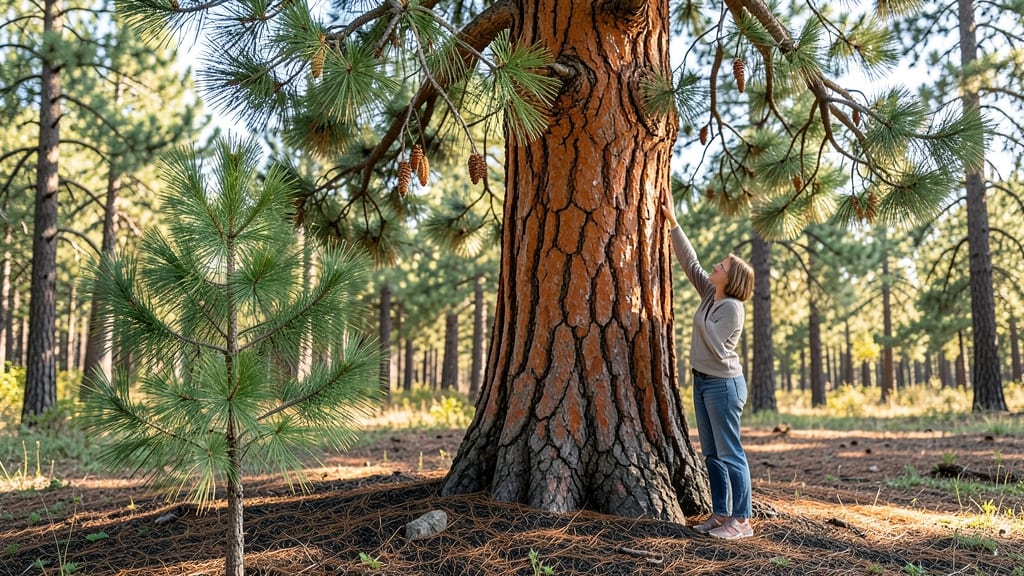
How Tall Do Pine Trees Grow: Height Ranges by Fastest-Growing Species

How To

How Tall Do Pine Trees Grow: Height Ranges by Fastest-Growing Species

Fastest-growing pine tree species and their maximum heights

Choosing a pine tree for your landscape means balancing beauty with space—some varieties grow faster than others, but their mature heights can vary dramatically. The fastest-growing pines often reach impressive heights in just a few decades, making them ideal for timber production or dramatic backyard statements.

Below, we’ll explore the top 10 fastest-growing pine species, their growth rates, and their maximum heights to help you plan your garden with confidence.

If you’re planting pines for privacy screens or timber yields, species like the Loblolly Pine or Slash Pine are excellent choices, growing over 100 feet tall in optimal conditions.

For smaller spaces, dwarf varieties like the Mugo Pine or Dwarf Alberta Spruce (often mistaken for pines) stay under 25 feet while still offering fast growth relative to their size.

Growth rates also depend on climate and soil quality. In USDA Zones 7-9, pines like the Ponderosa Pine can grow 2-3 feet per year in ideal conditions, while colder climates may slow growth to 1 foot per year.

Always check your local microclimate before selecting a species to avoid disappointment.

How to predict your pine tree’s height based on location and care

Predicting your pine tree’s height isn’t just about the species—it’s a mix of location, soil conditions, and care habits. Even the fastest-growing pines like the Ponderosa Pine can stall if planted in poor soil or shaded areas.

I’ve learned that sunlight exposure alone can dictate whether a 50-foot tree reaches 80 feet or stays at 40 feet.

Start by checking your USDA hardiness zone. Pines thrive in zones 3-8, but their growth rate slows in colder climates.

For example, a Scots Pine in zone 4 may grow 6 inches per year, while the same tree in zone 7 could surge to 12 inches annually. Your local climate sets the baseline—then, it’s up to you to optimize the rest.

🌲 Pro Growth Tip:

Soil pH matters! Pines prefer acidic soil (pH 4.5-6.0). Test your soil—if it’s alkaline, amend with sulfur or peat moss to boost growth by 20-30%. A well-draining, sandy-loam mix also prevents root rot, which stunts height gains.

Next, focus on watering habits. Young pines need deep, infrequent watering—think 10-20 gallons every 1-2 weeks—to encourage deep root growth. Overwatering leads to shallow roots, which slows height progression.

I once saw a Loblolly Pine sapling grow 3 feet in a year with proper watering, while a neglected neighbor tree grew just 1 foot.

Pruning plays a surprising role too. Never top your pine tree—this stresses the tree and triggers sprout clusters that weaken its structure. Instead, remove only dead or crossing branches in late winter. Strategic pruning can increase height by 10-15% by improving airflow and sunlight penetration to the canopy.

Finally, consider spacing and competition. Pines planted too close to buildings, power lines, or other trees will compete for nutrients and grow slower. Leave at least 10-15 feet between your pine and obstacles.

In my own yard, a White Pine planted 8 feet from a fence grew 50% slower than one with open space.

With the right location, soil prep, and care routine, you can push your pine’s height potential—without aggressive pruning. Track growth annually by marking the trunk with a paint stick in early spring. Over time, you’ll spot patterns that help you fine-tune care for even faster results.

★★★★★5.0(8 reviews)
Categories How To
Species Mature Height (ft) Annual Growth (ft) Best For USDA Zones
Loblolly Pine (Pinus taeda) 80–120 ft 2–3 ft Timber, erosion control 6–9
Slash Pine (Pinus elliottii) 70–100 ft 2–4 ft Fastest-growing timber pine 7–10
Ponderosa Pine (Pinus ponderosa) 100–200 ft 1–2 ft Drought-resistant landscapes 3–8
Eastern White Pine (Pinus strobus) 60–80 ft 1–2 ft Shade tolerance, wildlife habitat 3–8
Shortleaf Pine (Pinus echinata) 50–70 ft 1.5–2.5 ft Rocky soils, wildlife 5–9
Austrian Pine (Pinus nigra) 30–50 ft 1–1.5 ft Urban landscapes, windbreaks 3–7
Virginia Pine (Pinus virginiana) 40–60 ft 1–2 ft Poor soils, wildlife 4–9
Mugo Pine (Pinus mugo) 10–25 ft 0.5–1 ft Dwarf hedges, rock gardens 3–7
Scots Pine (Pinus sylvestris) 50–100 ft 1–2 ft Cold climates, timber 2–7
Jack Pine (Pinus banksiana) 40–60 ft 1–1.5 ft Wildfire-prone areas 2–6