
Pruning
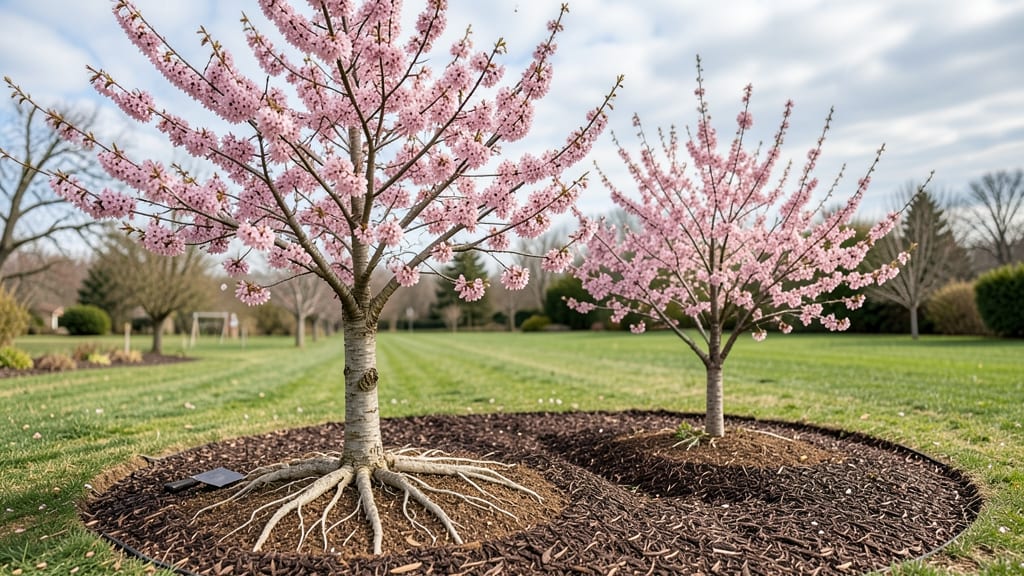
Flowering cherry tree roots grow aggressively, reaching 12–18 inches deep and spreading 1.5–2 times the tree’s canopy width horizontally. Their expansive lateral growth can crack sidewalks or damage foundations, so prune roots annually and plant at least 15 feet away from structures.
Understanding how flowering cherry tree roots behave is key to preventing headaches down the road. 🌳 These trees develop a mix of primary roots (deep anchors) and secondary roots (aggressive lateral spreaders), with growth patterns that accelerate in spring and early summer.
Sandy soils encourage deeper root penetration, while clay soils force roots to spread wider—both scenarios mean more potential for property damage. The Prunus serrulata variety, popular for its stunning blooms, is especially notorious for its invasive lateral roots, which can outcompete nearby plants and even lift pavement over time.
To minimize issues, focus on proper planting placement and soil health. 💛 A well-aerated, slightly acidic soil mix (pH 6.0–7.0) encourages balanced root growth, while a 3–4 inch layer of mulch helps regulate moisture and temperature.
If you're planting near hardscapes, consider installing a 18-inch deep root barrier during installation—this gives roots room to grow vertically while containing lateral spread. For established trees, annual root pruning in late winter (before new growth) prevents overcrowding and maintains structural integrity.
💡 In This Article
- How Flowering Cherry Tree Root Systems Develop Over Time
- Best Practices for Planting and Managing Flowering Cherry Tree Roots
How flowering cherry tree root systems develop over time
Flowering cherry trees (Prunus serrulata) develop a fibrous root system with two distinct growth patterns: primary roots dive vertically for stability, while secondary roots spread laterally in search of water and nutrients.
The vertical roots typically reach 12–18 inches deep within the first 3–5 years, while lateral roots extend 1.5–2 times the tree’s canopy width—meaning a 20-foot-wide canopy can push roots 30–40 feet outward.
This aggressive spread is driven by the tree’s need to access moisture and nutrients efficiently, especially in nutrient-poor soils common in urban planting zones.
The soil type dramatically alters this growth pattern.
In sandy soils, roots penetrate deeper (up to 24 inches) to reach groundwater, while in clay soils, they spread wider (up to 2.5 times canopy width) due to poor drainage. 🌱 For example, a Prunus serrulata planted in heavy clay may develop roots just 6–10 inches deep but extend 50 feet laterally, increasing the risk of sidewalk heaving or foundation pressure.
The tree’s natural tendency to outcompete nearby plants—through allelopathic chemical release—also accelerates this lateral growth, making it a challenge for gardeners with established lawns or shrubs.
Seasonal growth peaks occur in spring and early summer, when soil temperatures rise above 55°F. During this time, root tips grow at a rate of 1–2 inches per week, with lateral roots prioritizing expansion over depth.
This is why late-winter root pruning (before bud break) is critical—it prevents the tree from redirecting energy into aggressive lateral growth during its most active period.
In contrast, shallow-rooted varieties like Prunus subhirtella grow roots only 8–12 inches deep but still spread 1.2–1.5 times canopy width, making them slightly less invasive but equally demanding of space.
Root competition becomes visible when flowering cherries outcompete nearby plants for water and nutrients. You’ll notice yellowing leaves on neighboring shrubs or stunted growth in perennials within a 10–15 foot radius of the tree.
This happens because cherry roots release phenolic compounds that inhibit seed germination and root growth in competing plants—a natural survival strategy that can turn your garden into a one-tree monopoly. 🌿 The Prunus serrulata variety, in particular, is notorious for this, which is why arborists recommend planting it at least 20 feet from other vegetation to minimize ecological warfare in the root zone.
One often-overlooked factor is the tree’s age-related root behavior. Young flowering cherries (under 5 years) focus on vertical growth, while mature trees (10+ years) shift energy to lateral expansion.
This shift explains why sidewalk cracks or foundation shifts often appear 5–10 years after planting—long after the initial planting site was chosen. Understanding this lifecycle helps homeowners anticipate and mitigate issues before they become costly repairs.
For instance, a 15-year-old cherry tree with a 25-foot canopy could have roots spanning 37–50 feet, making retroactive root barriers nearly impossible to install effectively.
To visualize this, imagine a 10-foot-tall flowering cherry with a 15-foot canopy. Its roots will likely spread 22–30 feet outward and penetrate 12–18 inches deep.
If planted 10 feet from a sidewalk, the lateral roots could reach the pavement within 3–5 years, causing heaving and cracking—a common complaint in suburban neighborhoods.
This is why the 15-foot buffer zone recommendation isn’t just a guideline; it’s a risk management strategy based on real-world growth data. 💡