
Pruning
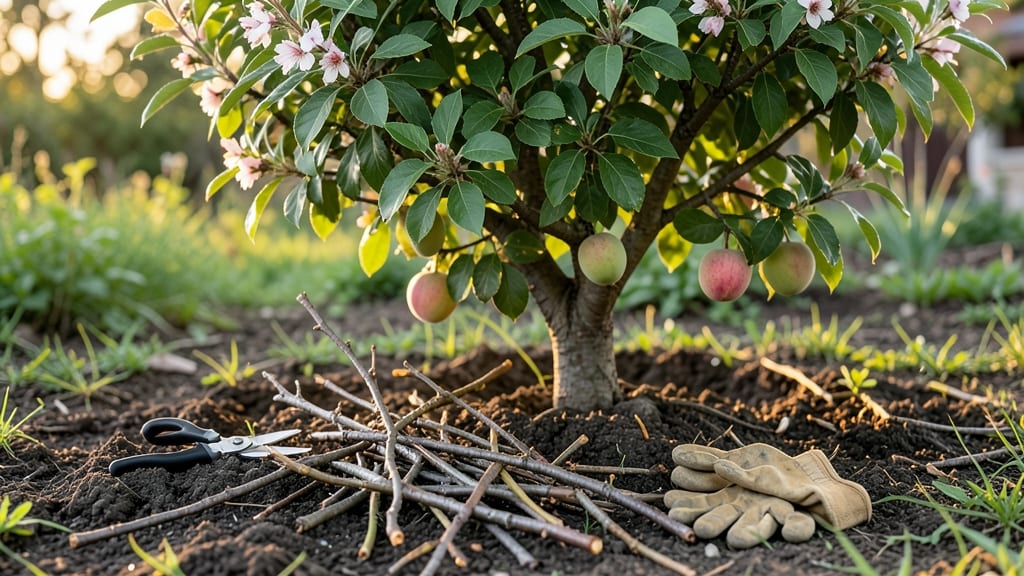
You can prune a peach tree after it blooms, but it requires extreme caution during late spring or early summer to protect fruit development and minimize pest risks. Limit yourself to removing only dead branches and thinning overcrowded growth.
Pruning after blooming disrupts the tree's natural cycle by removing potential fruit-bearing wood that's already formed for next season. 🌿 The biggest risk is weakening the tree's ability to produce flowers, which means fewer peaches the following year.
Even worse, fresh cuts create entry points for fungal diseases and pests that thrive in warm summer conditions. If you must prune late, wait until after harvest when the tree has redirected energy away from fruit production and focus only on structural improvements.
For safe late-season pruning, use sharp, sterilized tools to make clean cuts just outside branch collars. Remove any branches that are crossing, rubbing, or growing inward to improve airflow and sunlight penetration.
Thin out crowded branches by about 20% to reduce competition for nutrients. Always work during cooler morning hours to minimize stress on the tree and avoid inviting pests.
💡 In This Article
- Why Late Pruning Harms Peach Tree Fruit Production
- Safe Late-Season Peach Tree Trimming Steps
Why late pruning harms peach tree fruit production
Peach trees rely on a precise biological cycle where flower buds form in late summer and early fall for the following year's harvest. When you prune after blooming, you're removing branches that may already contain these dormant flower buds—some of which could have been set for next season's crop.
Studies show that aggressive late pruning can reduce flower bud formation by up to 30%, directly translating to fewer peaches. The tree's energy, which would normally go toward fruit development, gets diverted to healing fresh wounds instead.
The timing matters because peach trees are particularly sensitive to stress during their fruit development phase (late spring to early summer). Each cut removes not just wood but also the tree's ability to photosynthesize efficiently.
For example, removing a 4-inch diameter branch can reduce the tree's leaf surface area by 15-20 square feet, limiting its capacity to produce sugars needed for both current fruit and next year's buds.
This is why professional arborists often recommend waiting until post-harvest (late July to early August) for any non-emergency pruning.
Fresh cuts also create perfect entry points for brown rot fungus (Monilinia fructicola), a common peach tree pathogen that thrives in warm, humid summer conditions.
The fungus can spread within 48 hours of a cut, turning healthy branches black and killing adjacent fruit. 🌱 Even with sterilized tools, the risk remains higher than during dormant season pruning.
The tree's natural defenses are weakened when it's already focused on fruit maturation, making it far more vulnerable to infection.
Another critical factor is the tree's hormonal response. Pruning stimulates the production of ethylene gas, which triggers abscission (leaf and fruit drop) as the tree prioritizes wound healing. In peach trees, this can cause premature fruit drop, reducing yield by 10-25% depending on the tree's health.
The hormonal shift also delays the formation of new flower buds, pushing back the blooming cycle by 2-4 weeks in some cases.
Consider this real-world example: A 5-year-old peach tree with a 12-foot canopy might produce 500-800 peaches in a normal season. If pruned aggressively after blooming, that same tree could see a 40% reduction in fruit count the following year due to lost flower buds and stress.
The long-term impact on tree health and productivity makes late pruning a gamble unless absolutely necessary.
For those who must prune late, the key is minimal intervention. Focus only on branches that are dead, diseased, or crossing—never remove more than 10-15% of the canopy in a single session.
This approach preserves the tree's structural integrity while allowing it to maintain its fruit production capacity for the next season.