
Plants
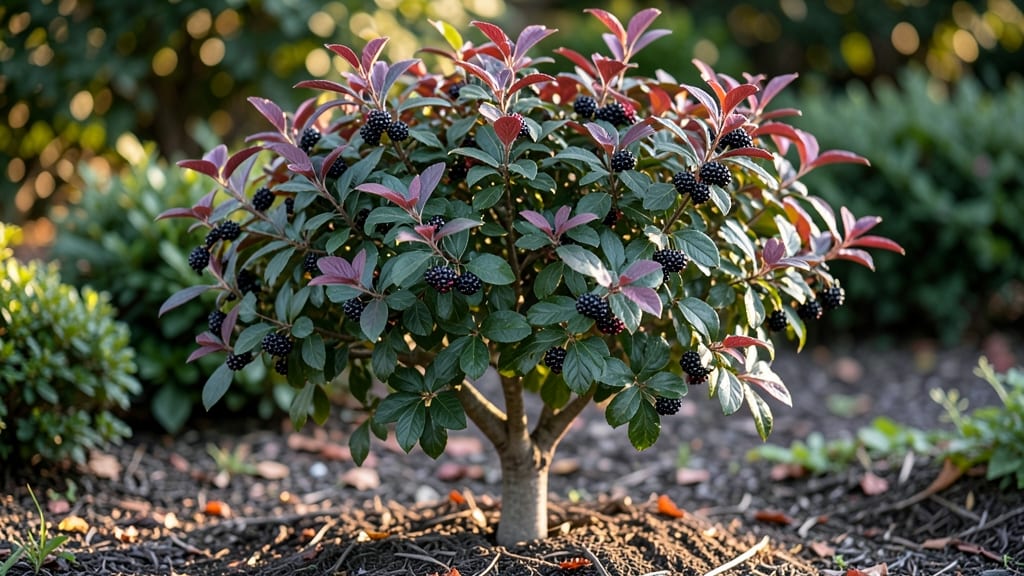
A chokeberry tree looks like a dense, multi-stemmed shrub or small tree with dark green, oval-shaped leaves that turn vibrant red in fall. Its small white flowers bloom in spring, followed by clusters of deep purple-black berries that persist through winter, often used in jams and teas.
A chokeberry tree, also called aronia, stands out with its striking seasonal transformation. 🌿 The leaves start as glossy dark green ovals in spring, then develop a fiery red hue in fall, creating a bold contrast against other garden plants.
Unlike many shrubs, chokeberry grows in a rounded, bushy form with multiple stems, reaching heights of 6 to 12 feet. This dense growth habit makes it an excellent privacy screen or ornamental plant, especially when planted in groups.
The tree's flowers appear in late spring as small, delicate white clusters, adding a subtle contrast to the dark foliage. What truly sets chokeberry apart are its berries—deep purple-black when ripe—which cling to the branches well into winter, providing both visual interest and culinary potential.
These berries are packed with antioxidants and have a tart flavor that works beautifully in preserves, syrups, or even baked goods.
💡 In This Article
- Chokeberry Tree Leaf, Bark, and Branch Characteristics
- Identifying Chokeberry Berries and Flowers for Gardeners
Chokeberry tree leaf, bark, and branch characteristics
The chokeberry's leaves are its most distinctive feature, starting as glossy, dark green ovals measuring about 1.5 to 3 inches long with finely serrated edges. These leaves contain 10-15 pairs of veins that create a subtle ribbed texture, giving them a slightly leathery feel when touched.
In late summer, they begin their transformation, turning a brilliant crimson red that deepens into burgundy by fall—this color change lasts until the first hard frost, making them a standout in autumn landscapes.
The bark of young chokeberry trees is smooth and grayish-brown, but as the tree matures, it develops a rough, furrowed texture with small horizontal lenticels (pores) that allow gas exchange.
Unlike maple trees, which have a more uniform bark pattern, chokeberry bark develops a scaly appearance over time, especially on older branches.
The tree's growth habit is uniquely dense, with multiple stems radiating from the base, creating a rounded, almost dome-shaped canopy that can reach 8-12 feet in height and width.
What sets chokeberry apart from similar shrubs like elderberry is its lack of thorns—unlike hawthorn or blackthorn, chokeberry branches are smooth and flexible. The branches grow in a semi-upright pattern, with younger shoots often arching slightly under the weight of berries.
This growth structure makes chokeberry ideal for hedges or wildlife-friendly plantings, as birds frequently feast on the berries without risking injury from thorns. 🌿 The tree's resilience in USDA zones 3-8 means it thrives in both cold northern climates and milder southern regions.
One fascinating detail is how chokeberry leaves respond to temperature changes. In early spring, new growth emerges with a light green tint before darkening, while cold snaps can trigger premature reddening.
This adaptability makes chokeberry a low-maintenance plant that still delivers year-round visual interest, from spring blooms to winter berries. The leaves also have a subtle almond-like aroma when crushed, though it's far more delicate than the scent of, say, mint or citrus.
For gardeners comparing chokeberry to other ornamental shrubs, the key identifiers are the leaf shape (oval with serrated edges), berry clusters (dense, spherical, and persistent), and bark texture (scaly rather than smooth).
Unlike serviceberry, which has single-stemmed growth, or dogwood with its opposite branching, chokeberry's multi-stemmed, rounded form is unmistakable. This makes it a favorite for pollinator gardens, as its white, five-petaled flowers (about 0.5 inches wide) attract bees and butterflies in late spring.
If you're growing chokeberry in containers, expect the roots to spread aggressively—this shrub prefers well-draining soil with a slightly acidic pH (5.0-6.5). In the wild, chokeberry often grows in sunny to partially shaded areas, tolerating urban pollution better than many ornamental shrubs.
The combination of its hardy nature, vibrant foliage, and edible berries makes it a dual-purpose plant for both aesthetics and harvest. 💫